- Home
- Departments
- Sheriff
- Navigation
- Boating Safety
Boating Safety
Maritime Emergency Situations
Emergencies on a boat often occur rapidly with little to no notice. Even on the relatively sheltered waters of our inland lakes, weather systems and powerful storm cells develop within minutes. The best way to respond to a boating emergency is to be prepared and plan ahead.
- Check, maintain, and ensure you know how to use all the required safety equipment listed below.
- Keep your cell phone and/or radio charged.
- Check the weather forecast and weather radar prior to getting underway and often while on the water.
- Leave a Float Plan with a family member or friend. The plan should include your depart location, departure time, how many people will be with you, general area where you plan to boat, and time you plan to be back ashore. If you have an emergency and fail to return home, your Float Plan will greatly assist searchers in locating you and your boat.
Steps to take in an actual boating emergency:
- Have everyone onboard put on their PFD/Life Jacket
- Contact emergency responders either via VHF Channel 16 or call 911 and provide the following information:
- LOCATION (latitude and longitude and/or a geographic description)
- NATURE OF DISTRESS (sinking, fire, out of gas, etc.)
- NUMBER OF PEOPLE ONBOARD
- DESCRIPTION of YOUR BOAT
- If the boat sinks or capsizes, keep everyone together and if possible, stay with the boat. Most modern boats do not completely submerge and it is much easier for searchers to locate a boat hull than people in the water.
- Try to reserve your flares until you spot searchers or other boats.
NOTE: In general, VHF Channel 16 is preferred as it allows other boats in the area to hear the distress call and may be able to respond, or at least relay your message. In the Finger Lakes region, however, VHF coverage may be limited, and you should not hesitate to use the 911 system.
Required Safety Equipment for Vessels on NY Waters
All motorized vessels greater than 16 feet in length operating on NY waters at a minimum must carry the following:
- wearable life jacket/PFD for each person on board
- throwable device
- sound producing device
- anchor with sufficient line
- flares / visual distress signals
- fire extinguisher
All non-motorized vessels (stand-up paddle boards, kayaks, canoes, sailboats, etc.) while operating during the daytime must at a minimum carry the following:
- wearable life Jacket/PFD for each person on board
- sound producing device – whistle is acceptable
Please see below for a more in-depth description of safety equipment requirements.
Personal Flotation Devices (PFDs) / Lifejackets
Every vessel operated upon the waters of New York must carry at least one United States Coast Guard (USCG) approved Type I or II or III Personal Flotation Device (PFD), or Life Jacket as they are more commonly known, for each person on board. All PFDs on board your vessel must be:
- serviceable - free of rot, tears, punctures, waterlogging and all straps functional.
- readily accessible - quickly reachable in an emergency situation, never kept in plastic bags or under lock and key.
- appropriate size for the intended wearer - check the USCG approval label for information on the intended user for a particular PFD.
Checking Your PFD
Most of us don’t have enough natural buoyancy to keep afloat; a PFD is designed to make up the difference. You should periodically test your PFD in shallow water to see if it has sufficient buoyancy to keep you afloat.
You should also check the straps and buckles of your PFD; a PFD will not work properly unless you are properly strapped into it. You should also check your PFD shell for tears in the fabric. Buoyant material may fall out of a tear. Leaving a PFD in direct exposure to the sun may cause the shell fabric to severely weaken, and tear when worn.
If you are using an inflatable PFD, you should check the cylinder and lanyard before each use. You should also review the manufacturer’s instructions for establishing a maintenance schedule.
Children Under the Age of Twelve (12)
Children under the age of 12 must wear a Type I, II, or III PFD on board a vessel unless they are in a fully enclosed cabin.
Throwable Devices (Type IV PFD)
These PFDs are designed to be thrown to a person in the water, and grasped and held until rescued. These devices are not intended to be worn. At least one Type IV PFD must be carried on all vessels 16 feet or greater in length.
Inflatable PFDs PFDs
While the United States Coast Guard is now approving inflatable PFDs for use on recreational vessels, please keep in mind that while they are comfortable and lightweight, they are not suitable for non-swimmers, water-skiers, youths under the age of 12, and riders of personal watercraft. To be considered a PFD under state law they must be worn. Coast Guard Approved Inflatable PFD’s are authorized only on recreational boats by a person at least 16 years of age.
For more information on selecting the correct lifejacket please refer to this U.S. Coast Guard information pamphlet.
Whistle or Horn
All mechanically propelled vessels 26 feet and greater in length must carry a mechanical whistle or horn capable of producing a blast of two or more seconds in duration. On vessels less than 26 feet in length a mouth whistle may be used.
Bell
All vessels 26 feet and greater in length are required to have a bell. The purpose of the bell is to comply with the rules of the road when anchored or grounded in reduced visibility.
Visual Distress Signals
State law requires all mechanically propelled vessels 16 feet in length or greater to carry a distress flag, fluorescent orange in color and at least one foot square. In addition, these vessels must also carry three handheld red flares. The flares must be U.S. Coast Guard approved. New flares generally have a three-year service life, and the ones you carry must not be past their expiration date. Never use road flares on your boat; they produce hot slag which can drip and burn either you or your vessel.
An electric distress light is acceptable for night use only and must be marked with an indication that it meets Coast Guard requirements in 46 CFR 161.013.
Anchor
All mechanically propelled vessels must carry an anchor and line of sufficient weight and strength to provide the vessel with safe anchorage. Select an anchor for the types of waters in which you’ll be operating. The anchor line should be between 4 and 7 times the depth of the water in which you would normally anchor.
Fire Extinguishers
Requirements for Mechanically Propelled Vessels:
- Outboards Less Than 26′ and of Open Construction – Exempt
- Less Than 26′ – One (1) USCG Approved Type B-1 Extinguisher
- 26′ to 40′ – Two (2) USCG Approved Type B-1 Extinguishers
- 40′ to 65′ – Three (3) USCG Approved Type B-1 Extinguishers
- On any vessel, a type B-II extinguisher may be substituted for two type B-1 extinguishers.
- Vessels equipped with approved fixed extinguishing systems may carry one less B-1 extinguisher.
Types of Extinguishers
The two most common types are Dry Chemical and Carbon Dioxide (CO2) extinguishers. Dry chemical is generally used on fires caused by flammable liquids such as fuel or grease (Class B fires) or electrical fires (Class C). CO2 extinguishers are effective against combustible solids (Class A) such as paper or wood as well as Class B or C fires.
Check your extinguishers frequently to ensure they are fully charged and undamaged. Check the pressure gauge or weigh it to determine the charge and replace cracked or broken hoses. Also ensure that the hoses are clear of obstructions.
Navigation Lights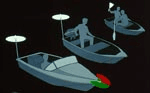
Vessels must display their required navigation lights at all times between sunset and sunrise, and during daylight periods of reduced visibility. Sail vessels less than 23 feet, as well as manually propelled vessels, may carry, in lieu of fixed lighting, a lantern with a white light that can be displayed in time to prevent a collision.
Law enforcement vessels may carry a blue, flashing light. No other vessels are permitted to carry a blue light. If you see this light, reduce speed, yield, and if necessary, stop your vessel.
Anchor Lights
All vessels between 7 (23.9 feet) and 50 (164.1 feet) meters in length, when at anchor, must exhibit an all around white light. By day, a black ball shape shall be exhibited.
Other Recommended Equipment
- Tool kit
- First aid kit
- Oar/paddle
- VHF radio
- Binoculars
- Cell phone
- flashlight
For complete information on NY State boating regulations and boating safety please see the attached NY Parks and Recreation Boating Guide: (Click on photo)